
ANIMAL A-Z…
Learn more about our amazing animal collection. Click on a letter below to find an animal or use our animal search:


Anemone, Beadlet (Actinia equina)
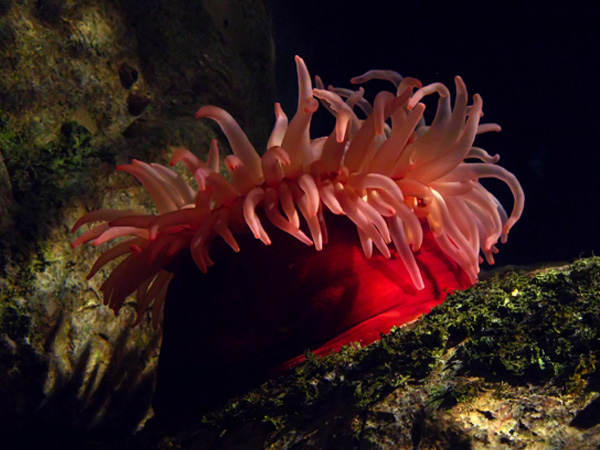
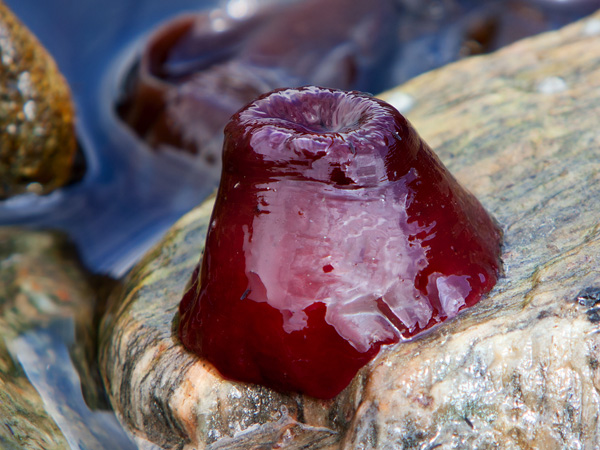
This stunningly bright anemone has a wide array of colour variation from green to red. It has up to 192 tentacles, arranged in 6 circles. When out of the water, the anemone retracts its tentacles and appears as a jelly-like blob. It is a small anemone and rarely reaches more than 6cm in diameter.
Fun Facts...
These sea anemones spend a good deal of time out of the water or even covered by sand, so they contract to conserve water.
They have three main defensive behaviours: inflation of the body column to reduce damaged areas, the sting of their tentacles and detachment off the subtrate, to escape predation.
Location...
Found in the North Atlantic Ocean and Mediterranean Sea. Highest concentration are around the British Isles. Populations also exist stretching down Africa's Atlantic coast.
Habitat...
Found in rockpools, coastal areas and even estuaries. These tough anemones can cope with wide variations in salinity, water flow and temperature.
Diet...
Bivalve molluscs, insects and isopods.

Anemone, Bubble tip (Entacmaea quadricolor)
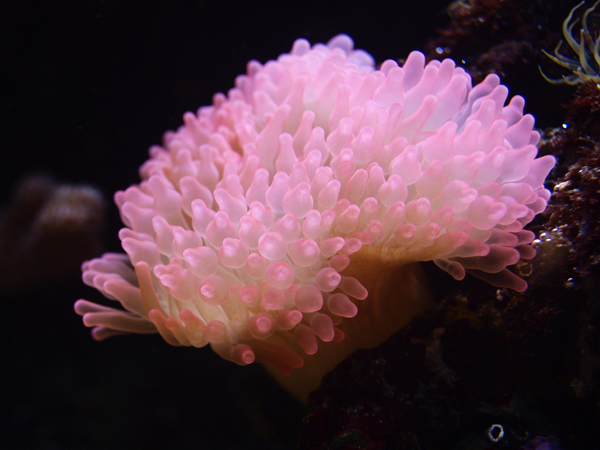
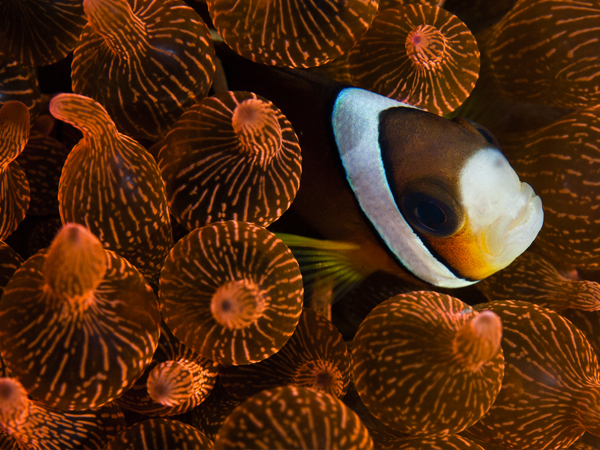
In the wild, this anemone is a natural home for several species of anemone fish, as predators cannot catch them through the anemone's stinging tentacles. Anemone fish include many species of clownfish.
Often pink in colour, this anemone is characterised by the bubble looking tip of its antennae, and can grow to a diameter of 30cm.
These anemone form a symbiotic relationship with a species of zooxanthellae algae and so energy is obtained by photosynthesis.
Fun Facts...
Anemone fish do not live rent-free; they chase away polyp-eating fish trying to feed on the anemone, and the anemone also gets fertiliser from the fish faeces!
Location...
Widespread in the Indo-Pacific region.
Habitat...
Found on coral reefs and rocky outcrops. This anemone prefers places with plenty of sunlight for photosynthesis, and a medium water flow.
Diet...
Nutrients from filter-feeding and energy from photosynthesis
Anemone, Dahlia (Urticina felina)
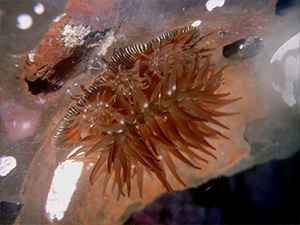
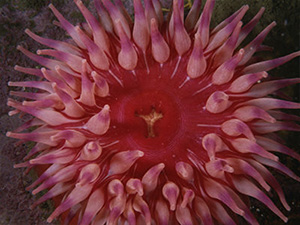
Dahlias are large anemones (base up to 15cm diameter) with up to 160 stout tentacles. Individuals from offshore tend to be larger. The colouration is variable, ranging through white, yellow, orange, red, blue, grey, purple and brown. The tentacles are usually banded but may be plain.
Fun Facts...
Like many other anemones, this species uses "nematocysts" which are stinging cells on the end of their tentacles to paralyse large prey.
Location...
Found on all coasts of the British Isles and Northwest Europe.
Habitat...
Attaches very firmly to rocks and boulders, typically in crevices, sometimes forming dense carpets. This species thrives in areas with strong wave action. Also occurs in estuaries where hard substrata are present.
Diet...
Carnivorous: shrimp, crabs, mussels and small fish.
Anemone, Parasitic (Calliactis parasitica)
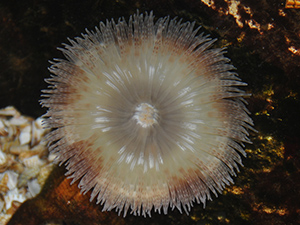
Parasitic anemones have a base of about 8cm in diameter and can grow to a height of 10cm. They have numerous, moderately sized tentacles which are yellowish, orange or cream in colour. The main column is yellow or brown with red or brown freckles or sometimes stripes.
Unlike the same suggests, the parasitic anemone is not actually parasitic as it lives on the shell of the crab and causes the crab itself, no harm. In fact the crab benefits from having the anemone living on its shell as it defends their home with its stinging tentacles. In return, the anemone gets a free ride to different feeding grounds, grabbing food as the crab scuttles along!
Fun Facts...
This species is usually associated with the common hermit crab. The relationship between them is called a mutualistic or symbiotic relationship, as both species benefit!
Location...
Found in the northeast Atlantic, including the English Channel, coasts of southwest Europe and in the Mediterranean.
Habitat...
Usually found on the backs of crabs, especially the hermit crab. May also be found on rocks in shore in sheltered locations.
Diet...
Molluscs and plankton.
Angelfish, Emperor (Pomacanthus imperator)
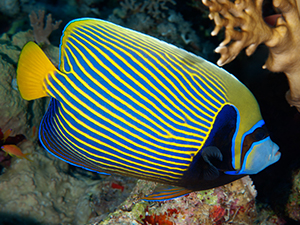
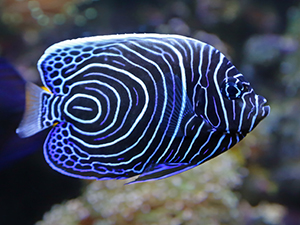
Like most angelfish, the colour of this species depends on its age. Juveniles are dark blue with white stripes and circles. Adults have strong yellow horizontal stripes down the sides of their body. They reach a length of about 40cm.
Fun Facts...
When mating, these angelfish form distinct pairs. Both young and adults may be found cleaning much larger fish, such as sunfish.
Location...
Can be found in the Indo-Pacific, from the Red Sea and East Africa, to Hawaii, southern Japan and down to the Great Barrier Reef.
Habitat...
Living mainly on protected shoreline reefs from 3-15m deep, often rich in hard and soft corals. This species of angelfish prefers sheltered spots and will seek out boulders, caves and coral crevices to retreat to when feeling threatened.
Diet...
Omnivore: Coral, crustaceans, small fish, algae.

Anthias, Lyre tail (Pseudanthias squamipinnis)
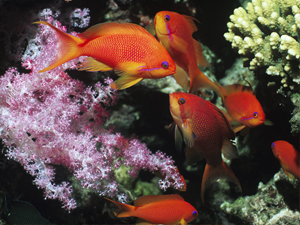
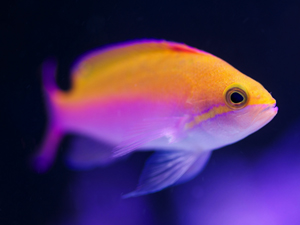
Lyre-tail anthias are also know as Indian Ocean wreck fish and sea goldies. They are sexually dimorphic as males vary in colour from bright red, pink or orange with lighter coloured bands of white or yellow across a third of the body. Females are yellow, with a pink or purple stripe running from the eye towards the pelvic fins. They grow to a length of about 15cm.
Fun Facts...
These fish live in harems of one male and about eight females. When the male dies, the larger, more dominant female will change sex into a male and take over the territory.
Location...
Found in the Indo-West Pacific from the Red Sea to South Africa, then east to Australia and north to Japan.
Habitat...
Inhabits coral outcrops or patch reefs of clear lagoons, channels or outer reef slopes.
Diet...
Feeds on zooplankton
Axolotl (Ambystoma mexicanum)
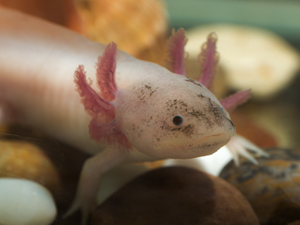
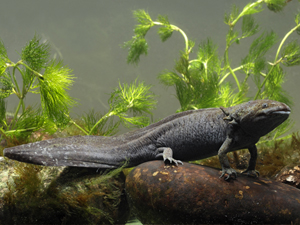
Axolotls are paedomorphic aquatic salamanders, meaning that they retain certain larval characteristics in the adult state. They have feathery external gills and finned tails for swimming.
Most wild axolotls are a dark mottled brownish-green colour where as those in captivity are usually albino.
They reach a length of 20cm but have been known to grow as long as 30cm.
The word axolotl comes from the native Aztec language and roughly translates to water slave or water sprite. In Aztec lore, Xolotl was a god and transformed himself into an axolotl to escape banishment.
Fun Facts...
During courtship, a pair of axolotl will be seen doing a 'waltz' with both animals moving in a circle. This leads to the male shaking his body, resembling a 'hula dance' with the female then mimicking his moves.
Location...
This species is kwonn only from central Mexico, on the southern edge of Mexico City.
Habitat...
Native to the ancient water system of canals and wetlands in Mexico City and requires deep-water with abundant aquatic vegetation.
Diet...
Will eat anything they can catch (molluscs, fish, arthropods) and are generally the top predator in their natural habitats.

OPEN: Daily from 10.00am.
LAST ADMISSION: 4.00pm
CLOSES: 5.00pm
ADMISSION:
Adult - £9.50 (16-64yrs)
Child - £8.50 (3-15yrs)
Under 3's - Free
Concessions - £8.99
(Senior Citizen, Disabled, Student).
See our Opening Times & Prices page for further info.

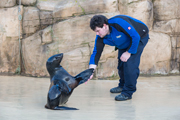
SeaQuarium are pleased and excited to announce a new arrival this Easter - a two-year-old South African fur seal.
MORE]
Welcome to our schools and groups fun page, showing the latest games, competitions & special offers...
FREE Discovery Trail Scratch Card for visitors!
During your visit to SeaQuarium, don’t forget to take part in our free children’s Discovery Trail scratch card quiz. Pick up your free scratch card on arrival, answer the questions found throughout the Discovery Trail and place your entry into our Monthly Prize Draw. Winners are randomly selected from correctly answered entries at the end of every month, and win an Adopt a Buddy package of their choice!
Find out more...
Downloadable Worksheets for Schools & Groups...
To make the most of your visit we have a range of worksheets available. Our specific topic worksheets are ideal to use before, during and after your visit, and can be backed up with a Guided Tour for only £1 extra per person.
Find out more...