
ANIMAL A-Z…
Learn more about our amazing animal collection. Click on a letter below to find an animal or use our animal search:


Goby, Mandarin (Synchiropus splendidus)
Fun Facts...
The mandarin goby has blue colouration due to cellular pigmentation. It is one of only two vertebrates known to produce their blue colouration this way, all other vertebrates produce their blue colouration due to purine crystal refraction.
Location... Western Pacific; Ryukyu Islands to Australia.
Habitat... Sheltered lagoons and inshore reefs. Found on silty bottoms with coral and rubble.
Diet...
Feed on amphipods and copepods.

Goby, Neon (Elacatinus oceanops)
Fun Facts...
Neon gobies are monogamous and can lay 500-800 eggs every ten days!
Location... Western Central Atlantic; sothern Florida to Belize.
Habitat... Inhabits coral heads.
Diet...
Eats ectoparasites found on other fish.
Goby, Rock (Gobius paganellus)
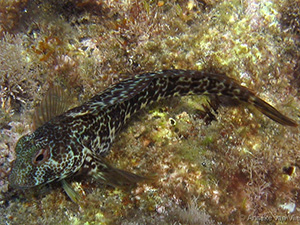
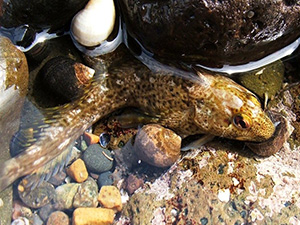
The rock goby is a moderately large goby reaching up to 12cm in length. It is pale brown in colour with purple-brown to black mottling. There is always a pale yellow band running along the top edge of the first dorsal fin. This band is a conspicuous orange colour in adult males. The nostrils are surrounded by 5-6 small, finger-like branches.
Fun Facts...
The gobies form one of the largest families of fish, with more than 2,000 species including one of the world's smallest vertebrates, just 1cm fully grown!
Location...
Southern and western coasts of Britain and all around the Irish coast at depths of 15m.
Habitat...
This goby is confined to rocky areas, which might explain its apparent absence from the east coast of Britain. Often found on the low shore beneath rocks and stone and also in seaweed covered rock-pools.
Diet...
Small crustaceans, small fish and seaweed.
Goldfish (Carassius auratus)
There are over a hundred varieties of goldfish and they vary in colour and physical characteristics. The common goldfish has two sets of paired fins - pectoral and pelvic, and three single fins - the dorsal, caudal and anal fin. They don't have any scales on their heads and have exceptionally large eyes. The largest type of goldfish can grow to about 45cm long and weigh 3kg!
Fun Facts...
When kept in an aquarium, goldfish will live up to about 10 years. In a pond, their lifespan can double, with some living up to 25 years. There are reports of one pet goldfish that lived up to 43 years!
Location...
Goldfish originate from China but have now be spread world wide in ornamental pools, ponds and slow-moving freshwater.
Habitat...
Found in slow-moving, freshwater usually in slightly sludgy water.
Diet...
Omnivorous, feeding on plants, insects and larvae.
Gramma, False (Pictichromis paccagnellae)
Fun Facts...
They are very aggressive towards other fish!
Location... Found in the Caribbean and tropical Western Pacific.
Habitat... Corals and rubble in shallow coastal reefs and towards the deeper reef drop-offs.
Diet...
Small crustaceans, shrimps, plankton, krill, mussels.
Grouper, Panther (Cromileptes altivelis)
The panther grouper is an extraordinary-looking fish with its bold black spots against a white or creamy-grey body. Juveniles have fewer, larger spots, which tend to become smaller and plentiful as the fish matures.
It can also be distinguished by its distinctive 'humpback' appearance, which earns it its other name, the 'humpback grouper'.
Sometimes panther groupers will take a rest and lean on their fins, to one side. See if you can spot ours doing this!
Fun Facts...
All panther groupers are born as female then will change to male if they reach a length of about 39cm or if a male in the group dies.
Location...
Found in the western Indo-Pacific, from southern Japan to southern Queensland in Australia.
Habitat...
Found mainly in lagoons and seaward coral reefs.
Diet...
Mainly carnivorous, feeding on smaller fish and crustaceans.

Grunt, French (Haemulon flavolineatum)
Fun Facts...
Their name comes from their ability to produce sound by grinding their teeth!
Location... Found in the Western Atlantic (Bermuda, Gulf of Mexico, West Indies, American coasts).
Habitat... Rocky and coral reefs, often under ledges or in seagrass beds.
Diet...
Crustaceans, molluscs, algae.
Grunt, Spotted (Plectorhinchus chaetodonoides)
There are over 30 recognised species of grunt (Plectorhinchus). The spotted grunt is white with small brown spots along its body.The juveniles look very different to the adults as they are brown with large white blotches. As the grunt ages, they gain more spots and the colour of them reverses. The young will also move differently to the adults. They move to mimic a poisonous flat worm as a predatory response. They are a large species and can grow to a total length of 60cm.
Fun Facts...
The heaviest known individual weighed 7 Kg!
This fish can be found at depths of 1 meter up to 30 meters
Grunts can grow up to 3ft in length.
Location...
The harlequin sweetlips are found in the tropical waters of the Indo-West Pacific. It is found in the Indian Ocean around the Maldives and Cocos Islands and the western Pacific from Sumatra to Fiji and New Caledonia, north to the Japanese Ryukyu Islands and south to Rowley Shoals, off the western coast of Australia.
Habitat...
Juvenile harlequin sweetlips are usually found in coral-rich lagoons, with adults found in deeper water, usually in sheltered areas such as under ledges or in caves. Usually found at depths of up to 30m.
Diet...
Feeds on crustaceans and invertebrates.
OPEN: Daily from 10.00am.
LAST ADMISSION: 4.00pm
CLOSES: 5.00pm
ADMISSION:
Adult - £9.50 (16-64yrs)
Child - £8.50 (3-15yrs)
Under 3's - Free
Concessions - £8.99
(Senior Citizen, Disabled, Student).
See our Opening Times & Prices page for further info.

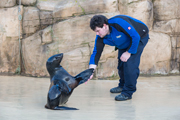
SeaQuarium are pleased and excited to announce a new arrival this Easter - a two-year-old South African fur seal.
MORE]
Welcome to our schools and groups fun page, showing the latest games, competitions & special offers...
FREE Discovery Trail Scratch Card for visitors!
During your visit to SeaQuarium, don’t forget to take part in our free children’s Discovery Trail scratch card quiz. Pick up your free scratch card on arrival, answer the questions found throughout the Discovery Trail and place your entry into our Monthly Prize Draw. Winners are randomly selected from correctly answered entries at the end of every month, and win an Adopt a Buddy package of their choice!
Find out more...
Downloadable Worksheets for Schools & Groups...
To make the most of your visit we have a range of worksheets available. Our specific topic worksheets are ideal to use before, during and after your visit, and can be backed up with a Guided Tour for only £1 extra per person.
Find out more...