
ANIMAL A-Z…
Learn more about our amazing animal collection. Click on a letter below to find an animal or use our animal search:


Cardinal, Banggai (Pterapogon kauderni)
The banggai is a small reef fish with elongated dorsal fins and a distinctive pattern with three black bars across the head and silvery body, black edges and white spots along the dorsal fins and white spots between the second and third black bars. Adults only reach 8cm including the tail, and you will often find this little fish in groups of up to 10 hiding in anemones, sea urchins and behind corals. These fish are mouth brooders.
Fun Facts...
The male holds the fertilised eggs in his mouth until they hatch, and even allows the fry to stay in his enlarged lower jaw to keep them safe, only spitting them out when they get too big!
The Banggai cardinalfish is the only member of its family which is diurnal.
The courtship behaviour of this fish is often initiated by the female. Once she has chosen a mate she will isolate him from the rest of the colony by creating a spherical spawning site that is 50-60cm in diameter.
Location...
Endemic to the reefs of the Banggai Islands off Sulawesi, Indonesia.
Habitat...
A variety of shallow tropical habitats, including coral reefs, sea grass beds and open areas of sand and rubble. Adults are usually found around the reefs and rubble areas, whereas youngsters will use sea grass beds to hide in. They will often also hide amongst the long spines of urchins, where they are protected from predators.
Diet...
Small crustaceans.
Carp, Common/Koi (Cyprinus carpio)
The common carp is the third most frequently introduced species in the world.
It can grow up to 120cm in length and weigh up to 60kg!
It has small eyes, thick lips, large scales, two barbels at each corner of the mouth and strongly serrated spines in the dorsal and anal fins.
Wild common carp are usually olive green, brown or silver in colour where as Koi carp are an ornamental strain which are brightly coloured with orange, yellow and black markings.
Fun Facts...
Common carp can live up to age of about 50 and were a luxury food item in the middle and late Roman period, where the Romans used to keep them in storage ponds.
Some ornimental breeding carp are valued at $AUS400,000 and record prices have been close to one million dollars!
Location...
Wild stocks are found only in the Black, Caspian and Aral Sea basins. Domesticated stocks are found all over Europe, South America and parts of Africa and Asia.
Habitat...
Warm, deep slow-flowing and still freshwater such as rivers and lakes which drain into the seas.
Diet...
They have a varied diet from molluscs and crustaceans to zooplankton and plant matter.
Carp, Mirror (Cyprinus carpio carpio)
The mirror carp was the first recorded mutation of the common carp and are very large fish which can reach lengths of 1.2metres and weigh up to 27kg! They have irregular, patchy scalation along the dorsal fin and lateral line which is thought to be a trait of how they were bred to make them easier to prepare for meals!
Fun Facts...
The biggest mirror carp ever to be recorded was said to weigh a mighty 7 stone!
Location...
Usually found in freshwater lakes and rivers around Europe and are particular abundant in Britain.
Habitat... Inhabits freshwater lakes and rivers.
Diet...
Feeds on aquatic insects and some plant matter.

Catfish, Channel (Ictalurus punctatus)
Channel catfish are usually a bluish olive, grey or black in colour, with a white underside and dark spots scattered along their sides. The male is usually darker with a wide head and long barbels surrounding the mouth.
They grow to a length of about 57cm and have a deeply forked tail.
Fun Facts...
After mating, the male channel catfish chases the female away, but she stays nearby to protect her eggs from a distance.
Both parents chase predators away and the male fans the eggs with his fins to keep a good circulation of water passing over.
Location...
Found mainly in North America from southern Canada down to northern Mexico
Habitat...
Inhabits well oxygenated rivers and streams but can also be found in reservoirs and ponds.
Diet...
Feeds mainly on small fish, crustaceans and aquatic insects.
Catshark, Grey bamboo (Chiloscyllium griseum)
The grey bamboo catshark has a fairly stout body with a long thick tail. The mouth is well in front of the eyes and it has a rounded snout. It has no dorsal spines and adults are completely greyish-brown with no patterns. Juveniles usually have dark bands and they can grow up to about 74cm in length.
Fun Facts...
The grey bamboo catshark is oviparous (egg laying) and deposits eggs in small oval cases on the sea bottom.
Location...
Found mainly inshore in the Indo-West Pacific region.
Habitat...
Found usually dwelling on the bottom of sandy or muddy shores, also on rocks and coral lagoons.
Diet...
Feeds mainly on small fish, shrimps, worms molluscs and crabs

Catshark, Small spotted (Scyliorhinus canicula)
The small spotted catshark is greyish-brown in colour and as its name suggests, covered by numerous small dark spots about the size of a pupil.
It can grow up to about a metre in length and has a prominent snout with large nostrils on the underside which connect to the mouth with a curved groove.
Fun Facts...
This species is also known as dog fish, rough hound and rock salmon, and lays eggs which are called 'mermaids purses'.
Location...
Distributed in the Northeast Atlantic from Norway and the British Isles, south to Senegal and the Mediterranean.
Habitat...
Inhabits continental shelves and uppermost slopes on sandy, coralline, algal, gravel or muddy bottoms.
Diet...
Feed on molluscs, crustaceans, other benthic invertebrates and small fish.

Chromis, Blue-green (Chromis viridis)
Fun Facts...
The females will deposit their eggs into a males nest. The nesting male then turns yellow and fans the eggs with his tail until they hatch.
Location... These fish are found in the Indo-Pacific and South Pacfic oceans, including the Red Sea.
Habitat... Inhabitat reefs with branching corals and lagoons.
Diet...
Phytoplankton, krill, brine, mysis shrimp.
Clownfish, Black and white (Amphiprion ocellaris var.)
Fun Facts...
All clownfish begin as males and only the large, dominant fish will change into a female. This is a variation of the common clownfish.
Location... Found in the Coral Sea, north-east Australia.
Habitat... Clownfish are found in coral reefs, particularly ones with anemone species.
Diet...
Mainly zoo plankton and algae. They also feed on parasites from their host algae.
Clownfish, Percula (Amphiprion percula)
The percula clownfish grows to 11cm in length. They are mainly orange in colour with 3 white vertical stripes at the base of the tail, from the middle of the dorsal fin and on the neck. Thick black bands separate the white and orange stripes. Clownfish often hide from predators in particular species of anemone.
Fun Facts...
The clownfish avoids getting stung by the anemone as it secretes protective mucus. The clownfishes' predators cannot get the clownfish from behind the anemone's stinging tentacles!
Location...
Indo-Pacific region, ranging from northern Queensland to Melanesia.
Habitat...
Clownfish are found on coral reefs, in particular ones with particular species of anemones. All clownfish are born as males. As juvenilles, they will stay together in small groups, hiding amongst the corals and small anemones. As they grow, the largest of the group will become and female, and her and the next largest will pair together for life. Pairs of clownfish will often be territorial about their host anemone and the surrounding area.
Diet...
Algae, zooplankton, worms and small crustaceans.
Clownfish, Red Sea (Amphiprion bicinctus)
The Red Sea clownfish is also known as the twoband anemonefish due to its yellow-orange colouring with two black-edged white bands. One band runs vertically just behind the head and the second between the dorsal fins, down to the abdomen. They reach a length of about 14cm.
Fun Facts...
Clownfishes are fiercly territorial and will dart out and 'attack' whatever comes close including divers!
Location...
As the name suggests, these fish are most commonly found in the Red Sea. They also are found in the western Indian Ocean.
Habitat...
Inhabit coral reefs and will be found amongst the tentacles on their host anemone.
Diet...
Feeds on benthic algae and zooplankton.
Clownfish, Tomato (Amphiprion frenatus)
As you may guess from the name, this species is redder in colour than typical clownfish. This species has a black-edged white bar just behind the head and the body is sometimes black, especially in older individuals. They can grow to 14cm in length, and females are usually larger. These clownfish prefer to nestle in purple anemones such as the bubble-tip anemone.
Fun Facts...
As they grow, the largest of the group will become a female, and her and the next largest will pair together for life.
Spawning occurs on a full moon.
Pairs of clownfish will often be territorial about their host anemone and the surrounding area.
As juveniles, they will stay together in small groups, hiding amongst the corals and small anemones.
Location...
Tropical reefs in the Western Pacific: Gulf of Thailand to south-western Palau, North to Southern Japan and South to Java, Indonesia.
Habitat...
Clownfish are found on coral reefs, in particular ones with particular species of anemones.
Diet...
Varied diet of zooplankton and algae.
Cockroach, Madagascar hissing (Gromphadorhina portentosa)
This species of cockroach is a shiny brown colour and oval shaped, with one pair of antennae and no wings. They have pads and hooks on their feet that allow them to climb smooth surfaces. They are named after the ability to make a hissing sound by exhaling air through breathing holes on their abdomen called spiracles.They hiss when startled to scare off predators, to assert dominance and as part of their mating ritual.
Fun Facts...
Cockroaches are some of the most primitive insects on our planet as they have been around for approximately 350 million years!
Madagascar hissing cockroaches are one of the largest species of cockroach in the world!
If you were to cut a cockroaches head off then it would survive for around 2 weeks as it doesn't use its head to house its brain or breathing apparatus. It does, however, need it for the mouth parts so that it can eat.
Location...
Found all over Madagascar.
Habitat...
Forest floors amongst leaf litter and logs.
Diet...
Fruit and plant material
Crab, Edible (Cancer pagurus)
This is a large species of crab, reaching up to 25cm in carapace width. They can vary in colour between a sandy beige, to a brighter orange, or a dark brown and can live up to 20 years. They are an important species harvested for the global seafood market! When on sediment substrates such as sand, these crabs dig large pits in order to find food.
Fun Facts...
Large females can carry 20 million eggs at any one time! The larvae are planktonic for up to 30 days after hatching.
Location...
Found in the North Sea, North Atlantic Ocean and in small populations in the Mediterranean Sea.
Habitat...
Living in depths of up to 100m, the edible crab is usually found in ocean floors consisting of a mix of mud and sand. Frequently hiding in rocky patches and crevices, small specimens can also be found in coastal areas and rock pools.
Diet...
Molluscs and small crustaceans.
Crab, Horseshoe (Limulus polyphemus)
The horseshoe crab is a 'living fossil' as it is almost identical to a species that was present during the Triassic period over 230 million years ago. Despite their name, they are not actually crabs and are more closely related to arachnids (spiders and scorpians). They have a long spine-like tail and the carapace is shaped liked a horseshoe and is greenish grey to dark brown in colour. It has 6 paired appendages, which are used for different functions such as walking, eating and mating. It has gills on the head area used for breathing and has 2 eyes on the head, five eyes on the carapace and two eyes underneath making a total of 9 eyes. The female's carapace can grow to a width of 35cm.
Fun Facts...
Horseshoe crabs are the closest living relation to the now extinct trilobites, which are often found as fossils.
Location...
The horseshoe crab is found along the east coast of North America, from Nova Scotia in Canada, south to Mexico.
Habitat...
Inhabits the muddy or sandy bottoms of bays and estuaries. They require sloping sandy beaches to lay their eggs.
Diet...
Dig for worms, molluscs and algae in the sediment.
Crab, Spiny spider (Maja brachydactyla)
The spiny spider crab is a a very large crab with a circular carapace (shell) which is bordered by strong spines. It is usually red, yellowish or brownish-red in colour and can grow up to 80cm from tip to tip of the claws.
Its shell and legs are often covered with algae and the males have powerful claws.
Fun Facts...
Spiny spider crabs are solitary animals but during the mating season they come together in huge numbers and create an unsightly mound of mating crabs!
Location...
Found usually in south and west Britain and Ireland but some individuals have been as far north as Scotland.
Habitat...
Inhabits rocky or coarse sandy areas of extreme low water to around 50m.
Diet...
Scavenge on the sea bed but will also eat mussels and shellfish.
OPEN: Daily from 10.00am.
LAST ADMISSION: 4.00pm
CLOSES: 5.00pm
ADMISSION:
Adult - £9.50 (16-64yrs)
Child - £8.50 (3-15yrs)
Under 3's - Free
Concessions - £8.99
(Senior Citizen, Disabled, Student).
See our Opening Times & Prices page for further info.

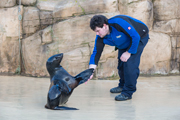
SeaQuarium are pleased and excited to announce a new arrival this Easter - a two-year-old South African fur seal.
MORE]
Welcome to our schools and groups fun page, showing the latest games, competitions & special offers...
FREE Discovery Trail Scratch Card for visitors!
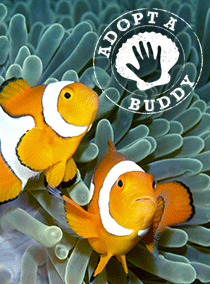
During your visit to SeaQuarium, don’t forget to take part in our free children’s Discovery Trail scratch card quiz. Pick up your free scratch card on arrival, answer the questions found throughout the Discovery Trail and place your entry into our Monthly Prize Draw. Winners are randomly selected from correctly answered entries at the end of every month, and win an Adopt a Buddy package of their choice!
Find out more...
Downloadable Worksheets for Schools & Groups...
To make the most of your visit we have a range of worksheets available. Our specific topic worksheets are ideal to use before, during and after your visit, and can be backed up with a Guided Tour for only £1 extra per person.
Find out more...