ANIMAL A-Z…
Learn more about our amazing animal collection. Click on a letter below to find an animal or use our animal search:


Wrasse, Ballan (Labrus bergylta)
The ballan wrasse is a heavy bodied fish, with a broad head, thick lips and small mouth.
The body, head and fins are often brownish red or red, with numerous small white spots. However they can also be greenish with white spots or irregular large vertical stripes.
Juveniles are usually bright emerald green and when mature, can reach a length of 50cm.
Fun Facts...
These fish are born female and change sex between 4 and 14 years old.
Location...
Widespread across the northeast Atlantic, from Norway to Morocco, including the Mediterranean Sea and Black Sea.
Habitat...
Inhabits inshore waters around rocks, offshore reeds and seaweeds.
Diet...
Feeds on crustaceans and molluscs

Wrasse, Corkwing (Symphodus melops)
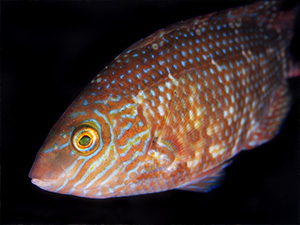
Corkwing wrasse are usually about 15cm long, but have reached lengths of 25cm.
They are highly variable in colour, depending on the environment and the age of the fish. They have a black spot in the middle of the tail stalk and a comma-shaped spot behind the eye. Females and juveniles tend to be brown or greenish-brown, while the males are typically more brightly coloured. Both sexes have lines on the head and gill covers which brown and pale blue in the female and bright green or blue in the male.
Fun Facts...
Some territorial males build a nest in rock crevices and guard them aggressively. Other males look like females and try to sneak-fertilise eggs.
Location...
British marine environments.
Habitat...
Rocks, rocky reefs and seagrass beds, and also in coastal lagoon habitats.
Diet...
Variety of prey but mainly bivalves and copepods.
Wrasse, Cuckoo (Labrus mixtus)
Fun Facts...
Females lay up to 1,000 eggs, which are they protected by the male whilst in the nest.
The females are able to change sex to males and develop the blue colouration.
Location... They are found in the Eastern Atlantic and the Mediterranean.
Habitat... Marine waters. The cuckoo wrasse also requires a rocky habitat including reefs to hide amongst.
Diet...
Mainly crustaceans but also fish and mollusks.
Wrasse, Goldsinny (Ctenolabius rupestris)
The goldsinny wrasse is brown, greenish or orange-red in colour and has two dark patches on its dorsal fin and in front of the tail fin. It has a small and pointy head, with a large mouth, fleshy lips and two rows of small teeth. They reach a length of 18cm.
Fun Facts...
These fish have been introduced into salmon farms as they prove to be a successful alternative to pesticides as they remove the parasite from the salmon.
Location...
Found in the eastern Atlantic, from Norway southwards to Morocco, including the Birtish Isles and the southern Baltic Sea.
Habitat...
Inhabits rocky, weed-covered substrates, to depths of about 50 metres.
Diet...
Feed on crustaceans, molluscs and parasites.
OPEN: Daily from 10.00am.
LAST ADMISSION: 4.00pm
CLOSES: 5.00pm
ADMISSION:
Adult - £9.50 (16-64yrs)
Child - £8.50 (3-15yrs)
Under 3's - Free
Concessions - £8.99
(Senior Citizen, Disabled, Student).
See our Opening Times & Prices page for further info.

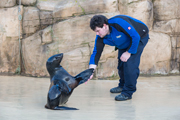
SeaQuarium are pleased and excited to announce a new arrival this Easter - a two-year-old South African fur seal.
MORE]
Welcome to our schools and groups fun page, showing the latest games, competitions & special offers...
FREE Discovery Trail Scratch Card for visitors!
During your visit to SeaQuarium, don’t forget to take part in our free children’s Discovery Trail scratch card quiz. Pick up your free scratch card on arrival, answer the questions found throughout the Discovery Trail and place your entry into our Monthly Prize Draw. Winners are randomly selected from correctly answered entries at the end of every month, and win an Adopt a Buddy package of their choice!
Find out more...
Downloadable Worksheets for Schools & Groups...
To make the most of your visit we have a range of worksheets available. Our specific topic worksheets are ideal to use before, during and after your visit, and can be backed up with a Guided Tour for only £1 extra per person.
Find out more...