
ANIMAL A-Z…
Learn more about our amazing animal collection. Click on a letter below to find an animal or use our animal search:


Parrotfish, Red Fairy Dwarf (Cirrhilabrus rubrisquamis)
Fun Facts...
When displaying to females, the sides of this wrasse turn almost white! This family of wrasses secrete mucus cocoons to sleep in. This is thought to protect them from nocturnal predators, who hunt by detecting scent.
Location... Found in the western Indian Ocean, from the Maldives to the Chagos Archipelago.
Habitat... Inhabits coral reefs, usually keeping close to the substrate.
Diet...
Feeds on zooplankton, flatworms and small invertebrates.

Perch, European (Perca fluviatilis)
The European perch is a dintinctive fish, with a dark green body, marked with dark vertical bands and an erect dorsal fin which is stiffened with spines and has a dark blotch at the rear end. The tail and anal fins are usually orange and the gill-covers are tipped with a sharp spine. They can grow up to about 25cm in length and can weight up to about 4kg.
Fun Facts...
Spawning takes place in April to May in which the female starts circling a chosen plant and starts spiralling around it. She then produces very sticky eggs in bands which she will twine around the plant for the male to fertilise.
Location...
Found in most European rivers, lakes and streams but notably not in Spain, Italy or Greece.
Habitat...
This species prefers slow-moving, well oxygenated freshwater, such as rivers, deep lakes and ponds.
Diet...
Feed on planktonic animals and anything that may be available to it.

Pipefish, Broadnosed (Syngnathus typhle)
Fun Facts...
Like its relative the seahorse, the male carries the eggs in a brood pouch which is found under the tail.
The compressed snout of this fish is taller than the eye in diameter.
Location... Found in the eastern Atlantic: Norway, Baltic Sea, British Isles to Morocco. Also throughout the Mediterranean, Black Sea and Sea of Azov.
Habitat... Found along coasts and estuaries amongst vegetation.
Diet...
Feeds on plankton
Pipefish, Snake (Entelurus aequoreus)
Fun Facts...
Like their relatives, the seahorse, it is the male that carries the eggs. They carry about 1000 eggs in a brood pouch, which is located under the tail. Young are onlu 1cm long when they hatch!
Location... The snake pipefish is native to the northeastern Atlantic ocean. It has been seen on the Icelandic and atlantic coasts from Troms, Norway to Gibraltar and Azores.
Habitat... They are generally found close to shore just below the tidal zone in amongst seaweed.
Diet...
Feed on small crustaceans and fish fry

Plaice (Pleuronectes platessa)
The plaice is a type of flatfish, which is brown in colour with orange or red spots. It can sometimes have white spots, especially when living in areas where the sediment has pale rocks or shells. It is oval in shape and can grow to about 60cm in length.
Fun Facts...
During development, the left eye of the plaice moves to the right side of the head. This allows the plaice to lie flat on the seabed.
The plaice has the ability to alter its body patterns, this is probably for camouflage.
Location...
The plaice is found in the Atlantic Ocean from the western Mediterranean and along the majority of European coasts. This species is common all around British and Irish coasts.
Habitat...
Usually found on sandy substrates at depths of between 10-50m, although can also be found on mud or gravel substrates.
Diet...
Worms, crustaceans and bivalves.
Pufferfish, Dog faced (Arothron nigropunctatus)
These are solitary fish that are often seen resting in a sponge or among coral braches. As with other types of puffer, they inflate themselves by gulping down water when disturbed.
The Dog faced Pufferfish has relatively thin skin and small short spines. Colours vary from a grey base colour to yellow always with black spots. Specimens may darken or lighten in colour due to environmental factors and individuals may drammatically change colour durting their lifetimes. It reaches a maximum length of 33cms. It has a round shape with a head and snout which at times look like a seal or a dog.
Also known as the black spotted toadfish, brown puffer or hush puppy puffer.
Fun Facts...
Parts of the flesh are poisonous if digested.
Location...
Widespread in the Indo-Pacific: East Africa to Micronesia and Samoa, North to Southern Japan, South to New South Wales.
Habitat...
Found on or near Coral reefs
Diet...
Feed on corals, crustaceans, sponges and algae
Pufferfish, Porcupine (Diodon holacanthus)
The porcupine pufferfish can grow up to about 61cm, is pale in colouration with dark patches along its side and back and has very large eyes. Its most distinguishing feature is the long spines that protrude all over its body, although these are actually modified scales which lie flat against the body for most of the time. It gets the name 'pufferfish' or 'baloonfish' as they can expand by swallowing mouthfuls of air or water. This is to make it look larger and to stop it from being swallowed by predators. This also causes the spines to stick out at right angles from its body making it look extremely dangerous. Because of the ability to expand, they have very elasticated skin and lack pleural ribs and a pelvic girdle.
Fun Facts...
Pufferfish are popular in Asian sushi but carry a toxic chemical in their skin and spines and have to be prepared extremely carefully to avoid poisoning the consumer!
Location...
Distributed circumtropically throughout the world in areas such as the Atlantic, Pacific and Indian oceans.
Habitat...
Found in relatively shallow areas of the ocean around grassy flats, coral reefs and mangroves.
Diet...
Feeds mainly on hermit crabs and gastropods such as limpets and whelks.
OPEN: Daily from 10.00am.
LAST ADMISSION: 4.00pm
CLOSES: 5.00pm
ADMISSION:
Adult - £9.50 (16-64yrs)
Child - £8.50 (3-15yrs)
Under 3's - Free
Concessions - £8.99
(Senior Citizen, Disabled, Student).
See our Opening Times & Prices page for further info.

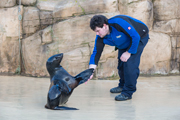
SeaQuarium are pleased and excited to announce a new arrival this Easter - a two-year-old South African fur seal.
MORE]
Welcome to our schools and groups fun page, showing the latest games, competitions & special offers...
FREE Discovery Trail Scratch Card for visitors!
During your visit to SeaQuarium, don’t forget to take part in our free children’s Discovery Trail scratch card quiz. Pick up your free scratch card on arrival, answer the questions found throughout the Discovery Trail and place your entry into our Monthly Prize Draw. Winners are randomly selected from correctly answered entries at the end of every month, and win an Adopt a Buddy package of their choice!
Find out more...
Downloadable Worksheets for Schools & Groups...
To make the most of your visit we have a range of worksheets available. Our specific topic worksheets are ideal to use before, during and after your visit, and can be backed up with a Guided Tour for only £1 extra per person.
Find out more...