
ANIMAL A-Z…
Learn more about our amazing animal collection. Click on a letter below to find an animal or use our animal search:


Bannerfish, Longfin (Heniochus acuminatus)
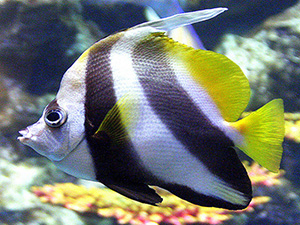

This species gets its name from its long dorsal fin, but is often confused with the moorish idol. Due to this it is often known as the fake moorish idol or poor man's moorish idol. It is a type of butterflyfish and can grow up to 25cm long. Its body is covered in white and black bands and it has bright yellow fins and tail.
Fun Facts...
You will often find this species eating the parasites off larger sea creatures!
Location...
This species is found in the tropical waters of the Indo Pacific and the Coasts of Africa.
Habitat...
Tropical waters including shallow sand banks and reefs.
Diet...
Zooplankton, small krill and other invertebrates.

Batfish, Roundfin (Platax orbicularis)
The roundfin batfish has a round body which is usually a reddish brown in juveniles and silvery grey in adults. They have a black bar over the pectoral fin and eye. They have large round fins and can grow to a size of about 55cm, giving this fish a commanding presence on the reef.
Fun Facts...
Baby roundfin batfish live inshore amongst mangroves and to protect themselves from predators, will float on their side on the water, resembling a floating leaf.
Location...
Found mainly in the Indo-Pacific, from the Red Sea and East Africa to the Tuamotu Islands, then North to Japan and South to New Caledonia. They have also been recorded off the coast of Florida and the Western Central Atlantic.
Habitat...
Usually inhabit shallow and deep reefs, with juveniles living within inner lagoons.
Diet...
Algae, invertebrates and small fishes.

Blenny, Tompot (Parablennius gattorugine)
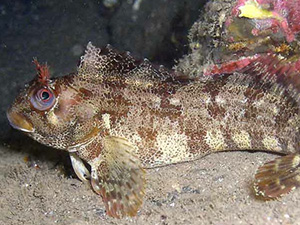
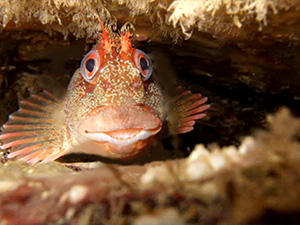
The tompot is a stoutly built blenny which is usually about 15-20cm long although it can be up to 30cm. One of the most distinctive characteristics of the tompot are the two branched head tentacles, which are located above the eyes, and with the bulging eyes and thick lips, this character can look quite comical. The front half of the long dorsal fin is composed of stiff, spiny rays, whilst the back half is made up of soft rays.
Fun Facts...
The tufts or "cirri" on a tompot blenny's head are thought to be used as sensory organs when searching for food.
Location...
This species is common on the south, west and north coasts of Britain and Ireland but can also be found in the Mediterranean Sea.
Habitat...
This species is usually found in holes, on rocky ledges or amongst boulders and seaweeds at depths down to approximately 20cm.
Diet...
Sea anemones and crustaceans.
Brittlestar, Common (Ophiothrix fragilis)
The brittlestar has five long arms, which radiate out from a central disc. The mouth of the brittlestar is located on the underside of this disc. Brittlestars can be difficult to spot, in the wild they would usually be found hiding in crevices under corals and usually emerge at night to feed on plankton. This species can be found around the majority of the British Isles and is often found in very large numbers, with as many as 2000 individuals found per square metre. Many animals will predate on the brittlestar, however the brittlestar has a number of methods to avoid predation, such as camouflage and hiding in crevices. The brittlestar can also detach any of it's arms as an escape mechanism, which it will then grow back.
Fun Facts...
Brittlestars filter plankton out of the water using their roughly spined arms. The brittlestar is very closely related to the starfish.
Location...
The common brittlestar can be found around all British and Irish coasts, with the exceptions of the east coast of Scotland, the Humber Estuary, north-east Anglia and the south Kent coast. This species is also distributed throughout the eastern Atlantic, from northern Norway to South Africa.
Habitat...
The common brittlestar is most often found on hard substrates, such as bedrock, boulders or coarse sediment.
Diet...
Plankton
Bull Huss (Scyliorhinus stellaris)
The bull huss is referred to by a number of other names, such as nursehound, large-spotted dogfish, greater-spotted dogfish, or greater-spotted catshark. It is a large catshark, which can reach lengths of 1.6 metres and is found distributed throughout the British Isles. It has a short and broad head, and fairly large pectoral fins. It is pale brown in colour dorsally, with small dark spots and has a white underbelly.
Fun Facts...
The bull huss is an oviparous fish, this means it lays eggs. The eggs are known as mermaid's purses and can often be found washed up on the beach around the British Isles.
Location...
The bull huss is found in the northeast Atlantic, from southern Scandinavia to Morocco, including in the Mediterranean Sea.
Habitat...
The bull huss is most commonly found at depths of around 20-63m and seems to have a preference for rocky substrates with good algal cover.
Diet...
Feeds primarily on crustaceans, but will also eat molluscs, such as squid, and bony fish.

OPEN: Daily from 10.00am.
LAST ADMISSION: 4.00pm
CLOSES: 5.00pm
ADMISSION:
Adult - £9.50 (16-64yrs)
Child - £8.50 (3-15yrs)
Under 3's - Free
Concessions - £8.99
(Senior Citizen, Disabled, Student).
See our Opening Times & Prices page for further info.

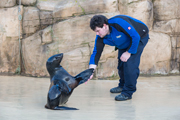
SeaQuarium are pleased and excited to announce a new arrival this Easter - a two-year-old South African fur seal.
MORE]
Welcome to our schools and groups fun page, showing the latest games, competitions & special offers...
FREE Discovery Trail Scratch Card for visitors!
During your visit to SeaQuarium, don’t forget to take part in our free children’s Discovery Trail scratch card quiz. Pick up your free scratch card on arrival, answer the questions found throughout the Discovery Trail and place your entry into our Monthly Prize Draw. Winners are randomly selected from correctly answered entries at the end of every month, and win an Adopt a Buddy package of their choice!
Find out more...
Downloadable Worksheets for Schools & Groups...
To make the most of your visit we have a range of worksheets available. Our specific topic worksheets are ideal to use before, during and after your visit, and can be backed up with a Guided Tour for only £1 extra per person.
Find out more...