
ANIMAL A-Z…
Learn more about our amazing animal collection. Click on a letter below to find an animal or use our animal search:


Bamboo shark, Brownbanded (Chiloscyllium punctatum)
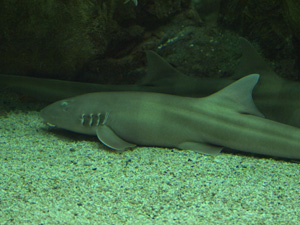
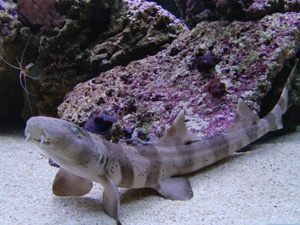
Fun Facts... Juveniles use their broad banded pattern as camouflage when hiding in reef crevices.
They have the abiloty to survive a complete tidal cycle exposed out of the water!
Location... They can be found in the Indo-West Pacific, from Australia to Eastern Asia.
Habitat... These sharks inhabit tropical warm waters including the Indian and Pacific Oceans and will spend time around the coral reefs and on sand substrates.
Diet...
Worms, shrimp and crabs

Bannerfish, Longfin (Heniochus acuminatus)
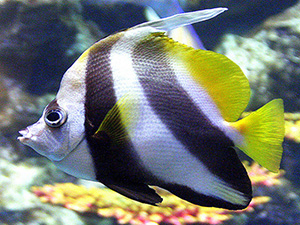

This species gets its name from its long dorsal fin, but is often confused with the moorish idol. Due to this it is often known as the fake moorish idol or poor man's moorish idol. It is a type of butterflyfish and can grow up to 25cm long. Its body is covered in white and black bands and it has bright yellow fins and tail.
Fun Facts...
You will often find this species eating the parasites off larger sea creatures!
Location...
This species is found in the tropical waters of the Indo Pacific and the Coasts of Africa.
Habitat...
Tropical waters including shallow sand banks and reefs.
Diet...
Zooplankton, small krill and other invertebrates.

Bull Huss (Scyliorhinus stellaris)
The bull huss is referred to by a number of other names, such as nursehound, large-spotted dogfish, greater-spotted dogfish, or greater-spotted catshark. It is a large catshark, which can reach lengths of 1.6 metres and is found distributed throughout the British Isles. It has a short and broad head, and fairly large pectoral fins. It is pale brown in colour dorsally, with small dark spots and has a white underbelly.
Fun Facts...
The bull huss is an oviparous fish, this means it lays eggs. The eggs are known as mermaid's purses and can often be found washed up on the beach around the British Isles.
Location...
The bull huss is found in the northeast Atlantic, from southern Scandinavia to Morocco, including in the Mediterranean Sea.
Habitat...
The bull huss is most commonly found at depths of around 20-63m and seems to have a preference for rocky substrates with good algal cover.
Diet...
Feeds primarily on crustaceans, but will also eat molluscs, such as squid, and bony fish.
Butterflyfish, Copperband (Chelmon rostratus)
Fun Facts... They are very territoral and may be aggressive towards members of their own kind. Their eggs are very buoyant and will float along with the current until they hatch!
Location... This fish is typically found in the Western Pacific, in the Andaman sea to the Ryukyu Islands and Australia.
Habitat... They can be found singly or in pairs along rocky shores, coral reefs and also in estuaries and silty inner reefs.
Diet...
Primarily carnivorous. Benthic invertebrates and mysis shrimp.
Butterflyfish, Falcula (Chaetodon falcula)
The falcula butterflyfish is mostly white becoming gradually yellow towards the dorsal fin. It has a series of narrow black stripes on its sides and two patches of black on the dorsal side. A black band runs across its eyes and it has a long snout and yellow tail. It can grow to a maximum of 20cm in length.
Fun Facts...
Butterflyfish form pairs when they mature and will stay mates for life until one dies.
Location...
Found mainly in the tropical Indian Ocean from Kenya to South Africa, Madagascar and the central Indian Ocean islands east to Java and western Thailand.
Habitat...
Abundant in areas of rich coral growth in lagoons or on seaward reefs.
Diet...
Feeds on hard and soft corals and invertebrates.
Butterflyfish, Racoon (Chaetodon lunula)
The racoon butterflyfish is also sometimes known as the crescent-masked butterflyfish or the lunule butterflyfish and is one of over 100 different species of butterflyfish. The racoon butterflyfish usually has a dark bar across the head that obscures the eye and a dark 'false eye' towards the end of their bodies. It is thought that this may confuse potential predators about the orientation of the fish.
Fun Facts...
The racoon butteflyfish can darken its colours and take on a blotchy appearance in order to blend in with its surroundings at night or when threatened.
Location...
Found in the Indo-Pacific, including East and South Africa, Hawaii, Southern Japan and Western Australia and is usually around shallow reefs.
Habitat...
The racoon butterflyfish is often found in lagoons or outer reefs, usually in rocky areas and at depths of 1-60m.
Diet...
Nudibrachs, benthic inverterbrates, algae and coral.
OPEN:
Weekdays 10am-5pm
(last admission 4pm)
Weekends 10am-6pm
(last admission 5pm)
ADMISSION:
Adult - £9.50 (16-64yrs)
Child - £7.50 (3-15yrs)
Under 3's - Free
Concessions - £8.50
(Senior Citizen, Disabled, Student).
See our Opening Times & Prices page for further info.

Staff at SeaQuarium Weston are getting ready to hold a week-long Love Oceans Event for Whitsun half-term.
MORE]
Welcome to our schools and groups fun page, showing the latest games, competitions & special offers...
FREE Discovery Trail Scratch Card for visitors!
During your visit to SeaQuarium, don’t forget to take part in our free children’s Discovery Trail scratch card quiz. Pick up your free scratch card on arrival, answer the questions found throughout the Discovery Trail and place your entry into our Monthly Prize Draw. Winners are randomly selected from correctly answered entries at the end of every month, and win an Adopt a Buddy package of their choice!
Find out more...
Downloadable Worksheets for Schools & Groups...
To make the most of your visit we have a range of worksheets available. Our specific topic worksheets are ideal to use before, during and after your visit, and can be backed up with a Guided Tour for only £1 extra per person.
Find out more...