
ANIMAL A-Z…
Learn more about our amazing animal collection. Click on a letter below to find an animal or use our animal search:


Piranha, Red-bellied (Pygocentrus nattereri)
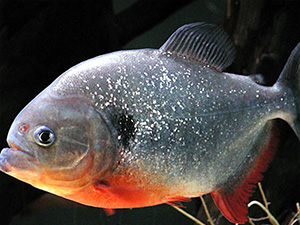
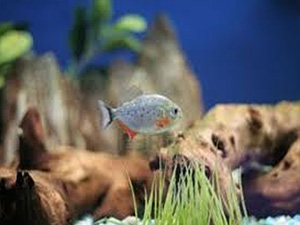
The red-bellied piranha is one of many piranha species living in South American rivers. Juveniles are silver in colour with dark spots. Adults have a reddish belly when fully grown. These medium sized fish can grow up to 33cm long and weigh up to 3.5kg.
Fun Facts...
Although they are known for being ferocious predators, they are actually primarily scavengers that use their powerful jaws and razor sharp teeth to eat other fish, insects, invertebrates and even plants.
Location...
Red-bellied piranha are found in the Amazon River Basin, coastal rivers of northeastern Brazil and the basins of Paraguay and Parana in South America.
Habitat...
Living in lakes, ponds, rivers and streams.
Diet...
Fish, invertebrates and plants

Plaice (Pleuronectes platessa)
The plaice is a type of flatfish, which is brown in colour with orange or red spots. It can sometimes have white spots, especially when living in areas where the sediment has pale rocks or shells. It is oval in shape and can grow to about 60cm in length.
Fun Facts...
During development, the left eye of the plaice moves to the right side of the head. This allows the plaice to lie flat on the seabed.
The plaice has the ability to alter its body patterns, this is probably for camouflage.
Location...
The plaice is found in the Atlantic Ocean from the western Mediterranean and along the majority of European coasts. This species is common all around British and Irish coasts.
Habitat...
Usually found on sandy substrates at depths of between 10-50m, although can also be found on mud or gravel substrates.
Diet...
Worms, crustaceans and bivalves.

Plecostomus, Common (Hypostomus plecostomus)
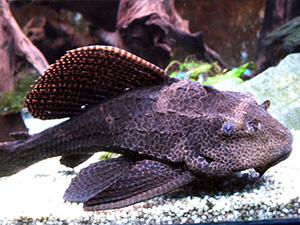
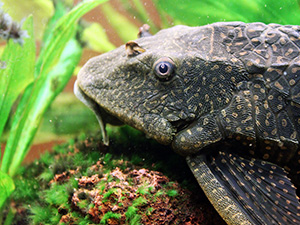
These friendly-natured fish are often called 'sucker-mouth catfish' or 'common plecos' and are common in captivity. They may grow up to 60 centimetres and belong to the armoured catfish family (loricariidae), named for the armour-like longitudinal rows of scutes that cover the upper parts of the head and body. The sucker-mouth catfish is named for its sucker-like mouth, which allows it to adhere to a surface, as well as to hold and rasp at food.
Fun Facts...
Many hobbyists keep aquarium plecos in aquariums because they keep the tank clean by feeding on algae, though rarely realise they can grow up to 60cm.
Location...
This species' native range is tropical South America; it naturally occurs in Brazil, Guyana, Trinidad and Tobago and Suriname, though it has been widely introduced to several river systems around the world.
Habitat... Inhabits freshwater and brackish water of river mouths.
Diet...
Algae, aquatic weeds and small crustaceans
Polyp, Button (Zoanthus sp.)
Fun Facts... Their polyps have the ability to sting other animals! They have a symbiotic relationship with marine algae called zooxanthellae, which is how they recieve their nutrients.
Location... Widesspread across the Atlantic Ocean and Pacific Ocean.
Habitat... Inhabit shallow tidal waters, lagoons, back reefs and other reefal areas. Sometimes found in deeper waters which is where the fluorescent orange varieties are found.
Diet...
Micro plankton, brine shrimp
Pufferfish, Figure Eight (Tetraodon biocellatus)
Fun Facts... Their name derives from the patterns across their back that resemble a figure of eight. Pufferfish have two pairs of teeth which are fused together giving the impression of a beak, allowing them to eat hard materials such as mollusks and crustaceans.
Location... Freshwaters of South East Asia.
Habitat... Brackish and feshwater estuaries and streams.
Diet...
Mollusks and crustaceans.
Pufferfish, Porcupine (Diodon holacanthus)
The porcupine pufferfish can grow up to about 61cm, is pale in colouration with dark patches along its side and back and has very large eyes. Its most distinguishing feature is the long spines that protrude all over its body, although these are actually modified scales which lie flat against the body for most of the time. It gets the name 'pufferfish' or 'baloonfish' as they can expand by swallowing mouthfuls of air or water. This is to make it look larger and to stop it from being swallowed by predators. This also causes the spines to stick out at right angles from its body making it look extremely dangerous. Because of the ability to expand, they have very elasticated skin and lack pleural ribs and a pelvic girdle.
Fun Facts...
Pufferfish are popular in Asian sushi but carry a toxic chemical in their skin and spines and have to be prepared extremely carefully to avoid poisoning the consumer!
Location...
Distributed circumtropically throughout the world in areas such as the Atlantic, Pacific and Indian oceans.
Habitat...
Found in relatively shallow areas of the ocean around grassy flats, coral reefs and mangroves.
Diet...
Feeds mainly on hermit crabs and gastropods such as limpets and whelks.
Pumpkinseed (Lepomis gibbosus)
The pumkinseed fish is a member of the sunfish family. The pumpkinseed can grow up to a maximum of 10 inches in length, but is more commonly 6-8 inches in length. The pumpkinseed is a yellow to olive green colour and is covered in bright gold or copper spots.
Fun Facts...
Male pumpkinseeds change colour during the breeding season, it therefore appears that visual cues must be important for either the males or females in the breeding season.
Location...
The natural range of the pumpkinseed is in North America, from New Brunswick down the east coast to South Carolina. However, the pumpkinseed fish has now been widely introduced throughout the whole of North America. The pumpkinseed has also been widely introduced in Europe, Africa and South America.
Habitat...
The pumkinseed is a freshwater fish and prefers warm, clear water in shallow areas around 1-2m deep. The pumpkinseed is usually found in areas of dense vegetation where they can hide from predators.
Diet...
Eat a wide variety of small prey, such as insects, insect larvae, snails, crustaceans and small fish.
OPEN:
Weekdays 10am-5pm
(last admission 4pm)
Weekends 10am-6pm
(last admission 5pm)
ADMISSION:
Adult - £9.50 (16-64yrs)
Child - £7.50 (3-15yrs)
Under 3's - Free
Concessions - £8.50
(Senior Citizen, Disabled, Student).
See our Opening Times & Prices page for further info.


Staff at SeaQuarium Weston are getting ready to hold a week-long Love Oceans Event for Whitsun half-term.
MORE]
Welcome to our schools and groups fun page, showing the latest games, competitions & special offers...
FREE Discovery Trail Scratch Card for visitors!
During your visit to SeaQuarium, don’t forget to take part in our free children’s Discovery Trail scratch card quiz. Pick up your free scratch card on arrival, answer the questions found throughout the Discovery Trail and place your entry into our Monthly Prize Draw. Winners are randomly selected from correctly answered entries at the end of every month, and win an Adopt a Buddy package of their choice!
Find out more...
Downloadable Worksheets for Schools & Groups...
To make the most of your visit we have a range of worksheets available. Our specific topic worksheets are ideal to use before, during and after your visit, and can be backed up with a Guided Tour for only £1 extra per person.
Find out more...