
ANIMAL A-Z…
Learn more about our amazing animal collection. Click on a letter below to find an animal or use our animal search:


Rabbitfish, Foxface (Siganus vulpinus)
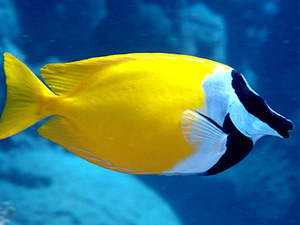
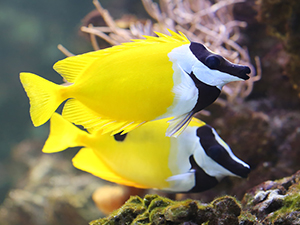
Bright yellow in colour with a distinctive striped black and white face, this unusual fish can obtain a length of 23cm.
Although they usually keep their colour day and night, they can turn a mottle brown colour when they are threatened by predators.
Their long fox-like snout is used to reach into crevices and obtain food.
Fun Facts...
This pretty fish can give a painful sting from its dorsal spines!
Location...
This species lives throughout the western Pacific.
Habitat...
Coral reefs.
Diet...
Algae, marine plants and small crustaceans.

Rabbitfish, Gold saddle (Siganus guttatus)
Fun Facts... The gold saddle's large yellow spot on their posterior mimics that of an eye in order to confuse predators!
Location... Turbid inshore reefs of the Eastern Indian ocean and Western Pacific.
Habitat... These fish inhabit brackish, marine waters. They also like to live amongst inshore reefs for cover and shelter. The fry settles in seagrass beds around river mouths and use the tide to leave the rivers when old enough.
Diet...
Herbivores. They will mostly eat algae.

Rabbitfish, Stellate (Siganus stellatus)
Fun Facts... Rabbitfish are so called because their nose looks similar to that of a rabbits nose!
The juveniles of this species tend to form large schools, where as adults pair up.
Location... These rabbitfish can be found in the Indian Ocean, Red Sea and the Andaman Sea.
Habitat... This fish is found in coral reefs. Juveniles are normally found in weedy estuaries.
Diet...
Benthic seaweeds
Rainbowfish Boeseman's (Melanotaenia boesemani)
Fun Facts... Once a female is ready to spawn, she can release up to 20 eggs a day!
Location... Endemic to the Ayamaru Lakes in West Papua, Indonesia.
Habitat... Shallow, swampy clear waters with lush aquatic vegetation.
Diet...
Small crustaceans, insects and some vegetation.

Rat, Brown (Rattus norvegicus)
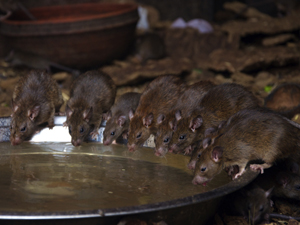
Fun Facts... Rats are highly intelligent and can be trained to carry out a variety of tasks.
They have hearing sensitive to ultrasound and their average heart rate is 300-400 bpm.
Rats are very good swimmers and can produce ultra sonic chirps which have been likened to laughter.
Location... Thought to have originated from northern China, this rodent has now spread to all continents except Antarctica. It has managed to spead worldwide by climbing aboard boats and other modes of transport. Alberta in Canada, is one of the only places in the world to operate a successful rat-control program, resulting in no rats at all!
Habitat... In its native range, rats inhabit stream banks, water courses and wetlands, as well as woodland and coastal areas. The brown rat tends to be found in areas that humans inhabit. They prefer out door environments, so will infest an area around a building rather then inside. They can create extensive burrows but will also utilise any man made burrows such as sewers.
Diet...
Omnivore-Will eat almost anything dead or alive, including insects, fish, carrion, vegetables, grain, soap and leather.
Ray, Thornback (Raja clavata)
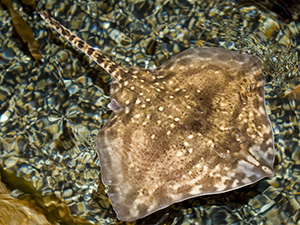
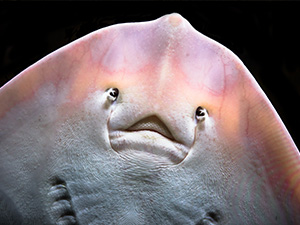
The thornback ray is also known as the thornback skate and the colour and patterns seen on this ray is often different depending on what part of the world it is found. The thornback ray get its name from the rows of spiky thorns found on their back and tail. Although these could cause injury if stepped on or touched, they are not venomous like the spines of a stingray.
Fun Facts...
The teeth of male thornback rays are sharper than those of females and juveniles. Thornback rays use coastal waters as nursery grounds, so juveniles are found most often in shallow water.
Location...
The thornback ray is found throughout the northeast Atlantic, from as far north as Iceland and as far south as Namibia. It is found throughout the Mediterranean Sea, Black Sea and Baltic Sea.
Habitat...
Around Europe, this species is usually found at depths of 10-60m, however the thornback ray is a seasonal migrator and will spend the winter months in deeper water before moving into shallower water in the late spring and summer months to breed. The thornback ray prefers to live in areas with soft sediment, such as mud and sand, but can also be found over gravel and rock beds.
Diet...
Primarily eats crustaceans, such as shrimp and crabs, and small fish, such as sandeels, dragonets, sprat and anchovies.

OPEN:
Weekdays 10am-5pm
(last admission 4pm)
Weekends 10am-6pm
(last admission 5pm)
ADMISSION:
Adult - £9.50 (16-64yrs)
Child - £7.50 (3-15yrs)
Under 3's - Free
Concessions - £8.50
(Senior Citizen, Disabled, Student).
See our Opening Times & Prices page for further info.

Staff at SeaQuarium Weston are getting ready to hold a week-long Love Oceans Event for Whitsun half-term.
MORE]
Welcome to our schools and groups fun page, showing the latest games, competitions & special offers...
FREE Discovery Trail Scratch Card for visitors!
During your visit to SeaQuarium, don’t forget to take part in our free children’s Discovery Trail scratch card quiz. Pick up your free scratch card on arrival, answer the questions found throughout the Discovery Trail and place your entry into our Monthly Prize Draw. Winners are randomly selected from correctly answered entries at the end of every month, and win an Adopt a Buddy package of their choice!
Find out more...
Downloadable Worksheets for Schools & Groups...
To make the most of your visit we have a range of worksheets available. Our specific topic worksheets are ideal to use before, during and after your visit, and can be backed up with a Guided Tour for only £1 extra per person.
Find out more...