
ANIMAL A-Z…
Learn more about our amazing animal collection. Click on a letter below to find an animal or use our animal search:


Tang, Clown (Acanthurus lineatus)
Fun Facts... Large male clown tang controls harems of females and has a well-defind feeding territory. They are always in motion and have a venomous caudal spine, which can cause a painful wound.
Location... Found in the Indo-Pacific, from east Africa, to the Great Barrier Reef.
Habitat... Inhabits exposed seaward reefs and adults are usually found in schools. Juveniles are solitary and are usually found on shallow rubble habitats.
Diet...
Mainly herbivorous, but also feeds on crustaceans

Tang, Lipstick (Naso lituratus)
This species can be easily recognised by two bright orange forward hooked spines on the base of the tail, its orange lips (where this species gets its name from) and black face mask.
Juveniles are grey and take on a more reddish tone as they mature. A black mask develops between the eyes and mouth and the 'lips' are highlighted by orange as they mature. Adult males often grow long streaming filaments off their tail.
Juveniles tend to group together, while mature individuals are solitary.
This species can grow to a maximum length of approximately 45 cm.
Fun Facts...
They have the ability to quickly and dramatically change colour, depending on mood or environment. When excited or hiding in the reef their body can become almost black with grey patches.
Location...
Widespread throughout western and central Pacific.
Habitat...
They are found above coral rocks and rubble in coastal and inner reef flats and reef slopes.
Diet...
Primarily a herbivore eating mainly leafy brown algae
Tang, Regal (Paracanthurus hepatus)
Regal tangs, also know as the common surgeonfish, are vibrant sky blue in colouration and have distinct oval-shaped bodies. Adult fish have dark narrow lines on the dorsal half of their body and a lighter, circular patch directly behind the pectoral fin. The pectoral and caudal fins are bright yellow. Juveniles start off bright yellow, with blue spots and their fins are blue. This colouration changes as they mature. They grow up to 38cm in length.
Fun Facts...
This fish have a toxic, razor-sharp caudal spine which they use to attack predators and are also used when males are fighting over a female.
Location...
Found in the Indian and Pacific oceans.
Habitat...
Inhabit tropical and sub-tropical coastal regions, hiding amongst coral reefs.
Diet...
Herbivores, feeding on algae which they pull from rocks and coral.

Tang, Unicorn (Naso unicornis)
The unicorn tang is greenish-grey in colour and can grow to a maximum length of 70cm, although more commonly reaches lengths of around 50cm. The adults can be recognised by a bony horn projecting from in front of the eyes.
Fun Facts... The unicorn tang is so named because of the horny projection coming from between its eyes.
Location...
Found in the Indo-Pacific, from the Red Sea and East Africa to the Hawaiian, Marquesas and Tuamoto Islands. It is found as far north as Southern Japan and as far south as Lord Howe and Rapa islands.
Habitat...
The unicorn tang is regularly seen in inshore coral reefs, as well as channels, moats and lagoons. Juveniles are usually found in shallow protected bays and harbours.
Diet...
Feeds on coarse, leafy brown algae.
Tang, Yellow (Zebrasoma flavescens)
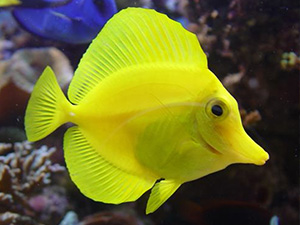
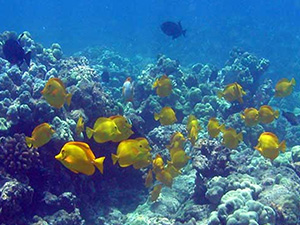
Yellow tangs are iridescent yellow with a snout-like mouth and can grow to a maximum of 20cm.
This species is active during the day where it can be found feeding in aggregations numbering several hundred, though will often find a solitary place to hide during the night.
Fun Facts...
Yellow tang is a long-lived species; the oldest wild yellow tang collected was 41 years old!
Location...
Indian Ocean and there is a large population around Hawaii.
Habitat...
Tropical inshore coral reefs, protected bays and lagoons.
Diet...
Varieties of seaweed
Tarantula, Green bottle blue (Chromatopelma cyaneopubescens)
Fun Facts... Like many other tarantulas, this species has fine hairs on its abdomen which it can flick at predators. These hairs can cause severe irritation, especially if they enter the eyes.
Location... Found in northern Venezuela in South America.
Habitat... These spiders are terrestrial burrowers, meaning they form burrows in scrubland and desert edges.
Diet...
Feeds on small invertebrates.
Terrapin, Yellow-bellied (Trachemys scripta scripta)
Fun Facts... This terrapin can live up to 30 years old. Females produce up to three clutches of eggs per year, containing between 5 - 20 eggs. Females travel over a kilometre from the water to find a suitable place to nest.
Location... These terrapins are native to eastern and central North America. However, they have been introduced to parts of Europe, Africa and Asia and are considered an invasive species.
Habitat... Inhabit a wide range of freshwater habitats, including rivers, swamps, lakes and ponds, usually in shallow, slow-flowing water.
Diet...
Juveniles are carnivorous, whereas adults feed mainly on aquatic plants.
Tetra, Congo (Phenacogrammus interruptus)
The Congo Tetra is covered by relatively large scales and has a copper/brown body with blue/green irridescent reflections.
Females and males are easy to differentiate. Adult males have long ray extensions to their tail dorsal and anal fins and are both larger and more brightly coloured than the females.
After an energetic courting the female will scatter about 300 eggs, sometimes more, which sink to the bottom. The eggs then hatch after around 6 days.
Fun Facts... The Congo Tetra is sometimes known as the 'jewel of the tetras' by fish-keepers due to their iridescent colours and peaceful nature.
Location...
Africa: Middle Congo basin.
Habitat...
Freshwater
Diet...
Feeds on worms, small insects, crustaceans and plant matter.
Tetra, Neon (Paracheirodon innesi)
Fun Facts... Females lay a batch of eggs which hatch in as little as 24 hours! Tetras 'turn off' their bright colours at night so they can't be as easily seen by predators.
Location... These fish are found in the stream tributaries of the Solimões River in South America.
Habitat... Inhabits blackwater or clear water in stream and tributaries.
Diet...
Worms, small insects, crustaceans and plant matter
Triggerfish, Clown (Balistoides conspicillum)
The clown triggerfish gets its name from its unique colouration. It has bright orange-yellow lips, half of its body is black with large white spots and the other half is mostly black with splotches of black outlined in yellow. Its tail is white and black and it has a pale strip just below the eyes. Juveniles are lighter in colour and darken as they mature. It reaches lengths of about 50cm.
Fun Facts...
When threatened, this fish darts into a small hole in the coral, extends the spines on its belly and head and bites into the coral, making it extremely difficult for predators to pull it out!
Location...
Found in the Indo-Pacific from east Africa, south to South Africa, then east through Indonesia to Samoa, north to southern Japan and south to New Caledonia.
Habitat...
Inhabits clear coastal, to outer reef habitats, often see near deep drop-offs.
Diet...
Carnivorous, feeding on sea urchins, crustaceans and molluscs.
Triggerfish, Indian (Melichthys indicus)
This species has a brown body and black fins with white lines at the base of the dorsal and anal fins. They can grow up to 25cm.
Indian Triggerfish dig their shelters under solid objects by swimming sand away. This is done by putting their mouth against a solid object and swimming like crazy, thereby creating a current that takes the sand away and making a little nest area.
Fun Facts... If they feel threatended the Indian triggerfish will use its spine to wedge itself into a hole or crevice.
Location...
Indian Ocean: Red Sea and East Africa eastward to western Thailand and Sumatra, Indonesia
Habitat...
Inhabits coral-rich seaward reef slopes.
Diet...
Feeds on sponges, algae, crustaceans and small invertebrates
Turbot (Scophthalmus maximus)
Almost circular in shape, the turbot is a flatfish with a large mouth and sharp teeth. Its eyes are on the left side of its head and have numerous bony tubercules on the upper side. Its is a master of camouflage and is sandy brown to dark brown in colour with blotches and spots helping it blend in perfectly with the sandy bottom of the sea. Its underside is white and it can grow to a length of 40cm.
Fun Facts...
Turbot's camouflage is so good that hardly any small turbot are caught by anglers. They can even change colour to blend in perfectly with whatever sea bottom they are dwelling on.
Location...
Found in the northeast Atlantic, thoroughout the Mediterranean and along the European coasts to the Arctic Circle. Also found in the Baltic Sea.
Habitat...
Adults inhabit sandy, rocky or mixed bottoms and are common in brackish waters.
Diet...
Feeds on other fish such as sand eels. Also eats squid, prawns and molluscs.
Turtle, Geoffroy's side-necked (Phrynops geoffroanus)
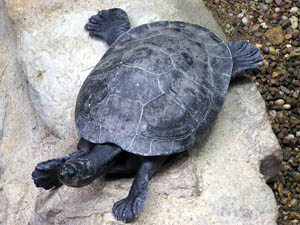
Fun Facts...
Location... The Geoffroy's side-necked turtle comes from South America and is found in Venezuela, Columbia, Ecuador, Peru, Brazil, Bolivia, Argentina and Guyana.
Habitat... They are found in fresh water in rivers, lakes and streams within tropical rainforests.
Diet...
Fish, snails, small mammals and aquatic plants
Turtle, Map (Graptemys sp.)
Map turtles are a type of freshwater turtle found in the rivers of the United States and Southern Canada and are easily recognised from other types of turtle by a distinctive ridge which runs down the center of their shell. Currently, thirteen different species of map turtle are known.
Fun Facts...
Map turtles get their name for the map-like markings found on their shell.
Location...
Found throughout the rivers of the United States and Southern Canada.
Habitat...
Diet...
Map turtles are omnivores and will eat a large amount of aquatic invertebrates, plants and animals such as snails and crayfish
Turtle, Snake-necked (Chelodina longicollis)
The snake-necked turtle is a medium sized turtle, which has an average length of 25cm. The most distinctive feature of this turtle is its very long neck. As its neck is so long, the snake-necked turtle will pull its head sideways into its shell, rather than straight back.
Fun Facts...
The female snake-necked turtles are bigger than the males.
Location...
The snake-necked turtle is from south-eastern Australia, and can be found in swamps, wetlands, rivers and streams from eastern Queensland to the south-western border of New South Wales.
Habitat...
The snake-necked turtle is semi-aquatic, meaning that they spend most of their time living in freshwater, such as swamps, wetlands, streams and rivers, but will also occasionally leave the water to bask in the sun. When in water, snake-necked turtles are primarily bottom-dwelling animals.
Diet...
Prey includes small fish, snails, tadpoles and plankton.
OPEN:
Weekdays 10am-5pm
(last admission 4pm)
Weekends 10am-6pm
(last admission 5pm)
ADMISSION:
Adult - £9.50 (16-64yrs)
Child - £7.50 (3-15yrs)
Under 3's - Free
Concessions - £8.50
(Senior Citizen, Disabled, Student).
See our Opening Times & Prices page for further info.

Staff at SeaQuarium Weston are getting ready to hold a week-long Love Oceans Event for Whitsun half-term.
MORE]
Welcome to our schools and groups fun page, showing the latest games, competitions & special offers...
FREE Discovery Trail Scratch Card for visitors!
During your visit to SeaQuarium, don’t forget to take part in our free children’s Discovery Trail scratch card quiz. Pick up your free scratch card on arrival, answer the questions found throughout the Discovery Trail and place your entry into our Monthly Prize Draw. Winners are randomly selected from correctly answered entries at the end of every month, and win an Adopt a Buddy package of their choice!
Find out more...
Downloadable Worksheets for Schools & Groups...
To make the most of your visit we have a range of worksheets available. Our specific topic worksheets are ideal to use before, during and after your visit, and can be backed up with a Guided Tour for only £1 extra per person.
Find out more...