
ANIMAL A-Z…
Learn more about our amazing animal collection. Click on a letter below to find an animal or use our animal search:


Filefish, Aiptasia eating (Acreichthys tomentosus)
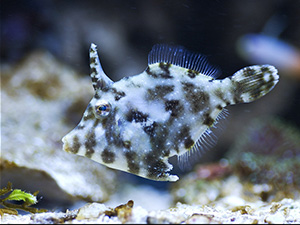
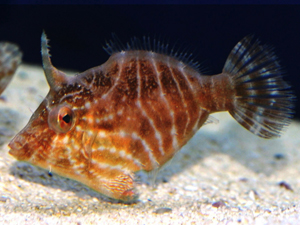
Known as the aiptasia eating filefish, matted filefish, bristletail filefish or tomentosus filefish. This shy mottled green or brown fish only grow up to around 12cm long. Although aggressive to other filefish, they are peaceful fish, prefering habitats with plenty of swimming spaces close to grazing and hiding spots. Eating algae and small crustaceans, they will also devour small pest anemones such as Aiptasia.
Fun Facts...
To deter predators these fish can raise their first dorsal fin and/or grind their front teeth, producing a low-pitched growling sound.
Location...
Found in the Indo-West Pacific: East Africa to New South Wales.
Habitat...
Inhabits shallow coral reefs, seagrasses and rubble areas.
Diet...
As the name suggests, their food of choice are pest anemones called aiptasias. They will also eat small crustaceans and molluscs

Filefish, Tassled (Chaetodermis penicilligerus)
Fun Facts... Their tail fin, dorsal fin and caudal fin are almost see through! This fish is diurnal.
Location... Distributed across the Indo-West Pacific: Malaysia to Japan and south to Australia.
Habitat... Lagoons, reefs and seagrass beds.
Diet...
Algae and small invertebrates.
Fire fish, Indian Ocean (Nemateleotris magnifica)
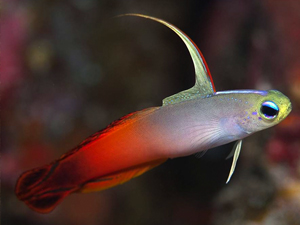
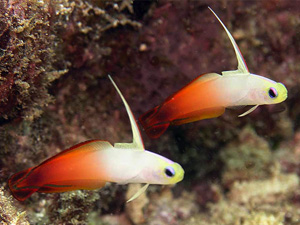
The Indian Ocean fire fish, also known as the fire goby, fire dartfish and magnificent dartfish, gets its names from its stunning colouration. It has a bold yellow head, which fades into white, which then turns a dramatic reddish-orange towards the rear. It is a small but long, slender fish, usually reaching a length of 9cm. The first dorsal spine is greatly elongated and may be as long as the fish itself.
Fun Facts... This fish uses its long dorsal spine to lock the fish into a crevice, much like a triggerfish.
It usually is found hovering over a burrow or bolt-hole, shaking its dorsal fin backwards and forwards.
Males of the species protect the eggs.
Location... Widespread in the Indo-Pacific: East Africa to Hawaii, Marguesan and Pitcairn islands, then north to the Ryukyu Islands and south to New Caledonia.
Habitat... Inhabits burrows in coral reefs in tropical waters, at depths of up to 60 metres.
Diet...
Feeds on zooplankton

Firefish, Purple (Nemateleotris decora)
Fun Facts... Purple firefish are monogamous, which means they mate for life. When startled these fish will dart into holes and hide.
Location... Indo-Pacific; Mauritius to Samoa.
Habitat... Found over hard, open bottoms at the base of reefs and reef drop-offs.
Diet...
Feed on zooplankton and crustacean larvae.
Flying fox fish (Epalzeorhynchos kalopterus)
Fun Facts... This fish migrates during the wet season, into floodplains or forested areas. It is though that humans may have disrupted these migratory patterns.
Location... Found in rivers in the Malay Peninsula, Borneo, Java and Sumatra.
Habitat... Inhabits rivers and hill streams over sandy or rocky substrates.
Diet...
Omnivore - worms, insects, plant matter, algae.

OPEN:
Weekdays 10am-5pm
(last admission 4pm)
Weekends 10am-6pm
(last admission 5pm)
ADMISSION:
Adult - £9.50 (16-64yrs)
Child - £7.50 (3-15yrs)
Under 3's - Free
Concessions - £8.50
(Senior Citizen, Disabled, Student).
See our Opening Times & Prices page for further info.

Staff at SeaQuarium Weston are getting ready to hold a week-long Love Oceans Event for Whitsun half-term.
MORE]
Welcome to our schools and groups fun page, showing the latest games, competitions & special offers...
FREE Discovery Trail Scratch Card for visitors!
During your visit to SeaQuarium, don’t forget to take part in our free children’s Discovery Trail scratch card quiz. Pick up your free scratch card on arrival, answer the questions found throughout the Discovery Trail and place your entry into our Monthly Prize Draw. Winners are randomly selected from correctly answered entries at the end of every month, and win an Adopt a Buddy package of their choice!
Find out more...
Downloadable Worksheets for Schools & Groups...
To make the most of your visit we have a range of worksheets available. Our specific topic worksheets are ideal to use before, during and after your visit, and can be backed up with a Guided Tour for only £1 extra per person.
Find out more...